AMC CEO Challenges Robinhood Stock Tokens
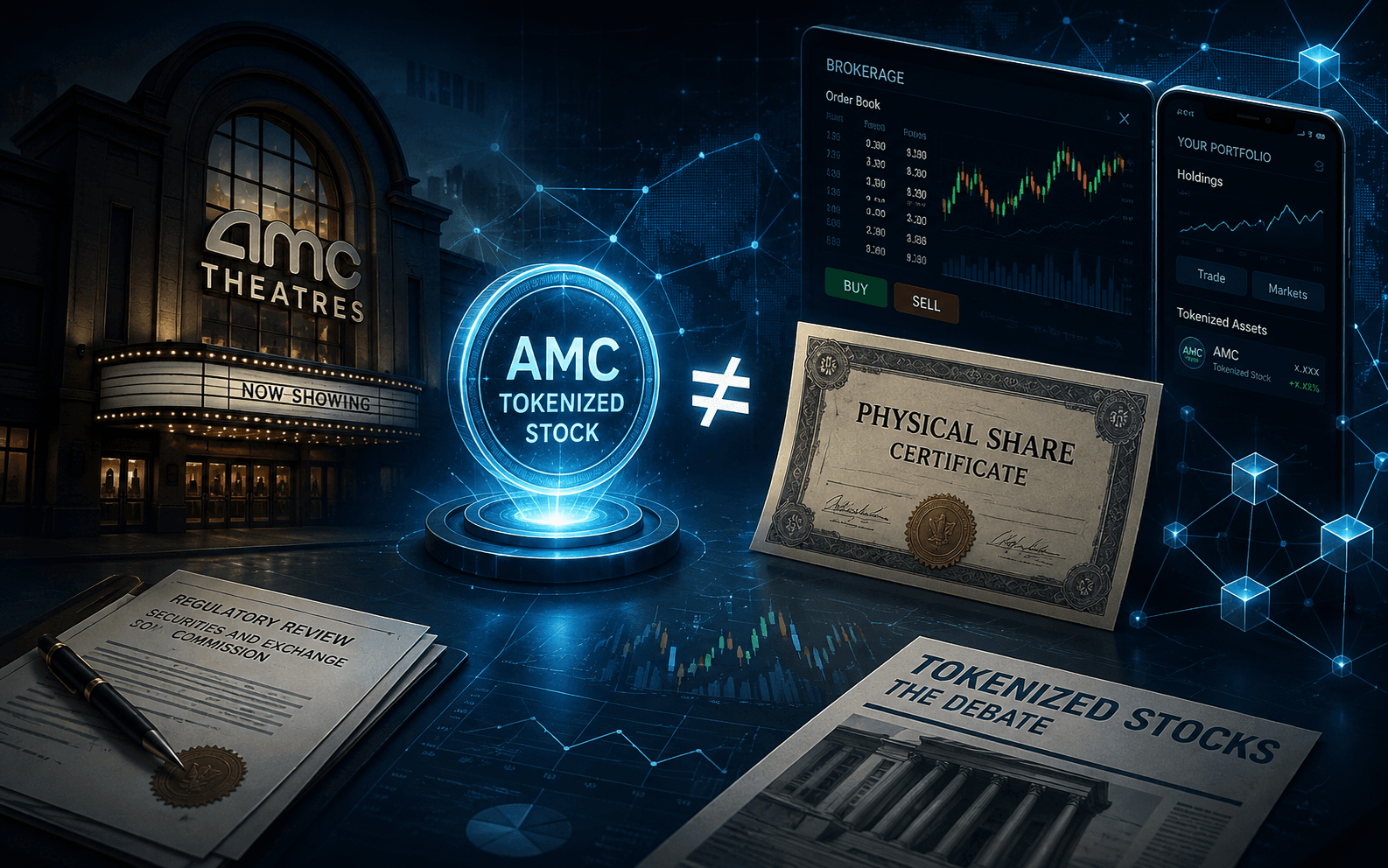
AMC Entertainment CEO Adam Aron has challenged Robinhood’s tokenized AMC offering, saying the company has no connection to the product. The dispute puts the legal rights behind tokenized stocks back in focus.
AMC CEO Challenges Robinhood Stock Tokens
AMC Entertainment CEO Adam Aron has publicly challenged Robinhood’s use of AMC in its tokenization push, saying the theater company did not authorize or participate in the offering.
In a post on X on Thursday, Aron said AMC had “no connection” to the initiative and said the company would ask outside securities counsel to examine the matter. His comments add a new layer to an increasingly important question in financial markets: when a blockchain token tracks the price of a stock, what exactly does the buyer own?
The issue is becoming more relevant as brokerages, crypto companies and traditional exchanges explore blockchain-based securities. The technology can make trading and settlement more flexible, but a token that follows a stock price does not necessarily provide the same rights as owning the stock itself.
Why AMC is challenging Robinhood stock tokens
Aron said Robinhood was apparently behind an effort involving tokenized real-world assets and Stock Tokens referencing AMC Entertainment and more than 190 other companies. He said AMC had not authorized the product and did not condone it.
The CEO also questioned the regulatory status of the products and said AMC would have its outside securities lawyers investigate.
Those comments are allegations from AMC, not a regulatory finding that Robinhood has violated securities laws. Robinhood's own disclosures show that its tokenized-stock business is designed for customers outside the United States and carries specific legal and regulatory restrictions.
Robinhood first launched Stock Tokens in June 2025 for eligible customers in certain European Economic Area jurisdictions. At that time, the company described the products as providing exposure to U.S. stocks and exchange-traded products without requiring customers to own the underlying securities.
Robinhood subsequently expanded its tokenization strategy. In 2026, the company launched Robinhood Chain, an Ethereum Layer 2 network built using Arbitrum technology and designed partly around tokenized real-world assets. Robinhood says its newer Stock Tokens are available to eligible users in more than 120 countries, although availability varies by jurisdiction.
A stock token is not necessarily a share
The biggest issue for investors is the distinction between price exposure and legal ownership.
Robinhood's original "Classic Stock Tokens" are explicitly described in its customer documents as derivative contracts. Their prices track the referenced stock or ETF, but the tokens do not give holders ownership rights in the underlying shares. Robinhood's terms also warn that investors can lose their entire investment, including as a result of Robinhood's insolvency.
That means buying a token linked to AMC is not automatically equivalent to buying AMC common stock through a conventional brokerage account.
A traditional AMC shareholder generally holds a legal interest in the company's common stock, subject to the normal rules governing securities ownership. Depending on the structure of a tokenized product, however, the token holder could instead have a contractual claim against the token issuer or another intermediary.
Robinhood's current disclosures make this distinction particularly important. The company says its newer Stock Tokens are tokenized debt securities issued by Robinhood Assets (Jersey) Limited that provide economic exposure to underlying securities but do not give investors legal or beneficial rights in those underlying securities.
So the term "tokenized stock" can describe products with materially different legal structures.
The SEC has recognized several tokenization models
U.S. regulators have also emphasized that blockchain technology does not automatically change the legal character of a financial instrument.
In January 2026, SEC staff published a statement describing tokenized securities and distinguishing between securities tokenized by or on behalf of an issuer and securities tokenized by unaffiliated third parties. Under an issuer-sponsored model, the blockchain record can become part of the authoritative ownership system.
The distinction matters because a token issued with an issuer's participation can be fundamentally different from a third-party instrument that simply references the company's shares.
SEC Commissioner Hester Peirce made a similar point in a 2025 statement, noting that tokenization does not remove an instrument from securities regulation. She also highlighted the possibility that third-party tokenized products can create counterparty risks or represent instruments distinct from the underlying security.
For investors, that creates a practical checklist: who issued the token, what backs it, who holds the underlying asset, what happens if the issuer fails, and whether the token holder receives voting, dividend or other shareholder rights.
Why tokenization is attracting Wall Street
Despite the controversy, the underlying technology has attracted substantial interest.
Blockchain-based securities can potentially support trading outside traditional market hours, automated settlement and more efficient transfer of assets. Robinhood has positioned its blockchain infrastructure around exactly these use cases, while traditional market infrastructure is also moving toward tokenization.
The New York Stock Exchange has proposed rules that would allow eligible securities to trade in tokenized form through a framework connected to the Depository Trust Company's tokenization pilot. The proposed structure is designed to keep tokenized securities within the existing national market system rather than creating an entirely separate market.
NYSE President Lynn Martin has also said the exchange's planned tokenization platform would directly link digital equities with their underlying shares, so the traditional and digital representations would constitute the same security rather than two separate products.
That approach contrasts with products where a third party creates a derivative or other instrument whose value simply tracks a stock.
AMC's objection exposes the central problem
The AMC dispute is therefore less about whether stocks can technically be placed on a blockchain and more about who has authority over the underlying economic and legal relationship.
The SEC's Investor Advisory Committee has noted that tokenized equity can be either "native," where the security is issued directly on a blockchain, or "wrapped," where a conventional security is held in custody and a token represents an interest connected to that position. The committee also warned that holders of third-party wrapped tokens may not have the same voting or bankruptcy rights as holders of issuer-sponsored tokenized securities.
That distinction could become increasingly important as more companies see their names and share prices represented in blockchain products.
Robinhood itself has acknowledged the potential for disputes with issuers. In its regulatory filings, the company says it could face contractual or legal challenges from companies whose securities are referenced by token products. It specifically disclosed that issuers may object to synthetic instruments referencing their securities and that such disputes could create litigation, reputational and operational risks.
What investors should watch next
The immediate question is how AMC's legal review develops and whether Robinhood provides additional clarification about the structure of the AMC-linked product.
The broader issue is likely to continue well beyond AMC. U.S. regulators and market infrastructure providers are working on ways to accommodate tokenized securities while maintaining established rules around custody, settlement, disclosure and investor protection.
For investors, the safest assumption is that a token carrying a company's ticker is not automatically the same thing as owning that company's stock.
Before buying a tokenized equity product, investors should check the issuer, legal structure, underlying assets, custody arrangements, redemption terms and shareholder rights. Those details can determine whether the investor owns an actual security, a tokenized representation of one, a derivative, or another contractual instrument.
Tokenization may eventually make financial markets faster and more accessible. But the AMC-Robinhood dispute shows why the legal rights attached to the token may matter just as much as the technology behind it.
Ryan Mitchell
Verified JournalistSenior Editorial Correspondent · MoneyAllotment
Markets columnist specializing in crypto assets, central bank policies, and macroeconomic trends.
This article was researched, written, and verified in accordance with MoneyAllotment's editorial standards. Our financial reporting is strictly independent and unaffected by commercial affiliations.
Reader Discussion (0)
Be the first to share your perspective on this report.
Further Dispatches & Related Analysis
More from Crypto news →
Bitcoin Price Outlook: Is Altcoin Season Coming Next?
Bitcoin has rebounded above $80,000 as rate-hike expectations ease, but the market has not yet confirmed a broad altcoin season. Here are the key signals to watch next.

Bank Stablecoin 2027: 21 Firms Plan Dollar Token
Twenty-one financial institutions are planning a new U.S. dollar stablecoin for 2027, with the project aimed at payments, settlement and institutional use.
Remixpoint Bitcoin Strategy: Company Sells Altcoins
Japan-listed Remixpoint changes its Remixpoint Bitcoin strategy by selling ETH, SOL, XRP and DOGE and concentrating its crypto holdings on Bitcoin.
Leave a Comment
Your email address will not be published. Required fields are marked *