••
High Yield Savings vs Money Market: Choosing the Best Option
Both accounts can park cash safely, but the better choice depends on rate stability, access, and fees. The math changes fast when balances rise or rates fall.
Share Article:

Editorial Illustration · MoneyAllotment
The 2026 choice starts with access, not yield
A high-yield savings account and a money market account can look nearly identical on paper. Both are deposit accounts, and both are commonly used for short-term cash reserves. The difference usually shows up in features and pricing, not in safety.
That matters because rate headlines can distract from the real question: how often will you touch the money, and what will the account cost you if you do? If the cash is meant to sit untouched for months, the highest APY may matter most. If you need flexibility for bills or irregular spending, the account's access rules can outweigh a small yield gap.
The safest way to compare them is to reduce each option to four inputs: APY, fees, minimum balance, and access tools.
How the math works on a simple balance
Use a clean annual estimate before you worry about promotional bonuses or tiered pricing. The base formula is:
Estimated interest = principal × APY
A USD 10,000 balance at 4.50% APY produces about USD 450 in interest over one year before tax and before any fees. If the money market account pays 4.75% APY on the same balance, the rough annual interest rises to USD 475. That USD 25 difference is real, but it can vanish quickly if the better-paying account charges a monthly fee or requires a higher minimum balance.
Now add a fee test.
Net annual return = estimated interest − total annual fees
If a money market account charges USD 10 per month and your balance earns only USD 120 in annual interest, you end up with a net of USD 0. If the same account earns USD 475 and has no fee, the full amount stays in your pocket. The spread is small only until it isn't.
For a broader household view, use a 50/30/20 Budget Calculator to determine whether the cash belongs in emergency reserves, near-term spending, or longer-term savings. The account type should follow the job the money is doing.
Where money market accounts can pull ahead
Money market accounts often justify their place through access features. Some offer debit cards, check-writing, or transfer structures that mimic a checking account with a higher yield. That can be useful for people who keep a large operating cushion and want one account for both safety and liquidity.
The trade-off is that money market accounts sometimes come with balance rules. A bank may require a minimum opening deposit, a monthly minimum to avoid a fee, or a tier that only pays the top APY once the balance clears a threshold. A strong headline rate is useful only if your balance qualifies.
The practical test is to ask three questions:
- What APY applies to my actual balance?
- What fee am I paying each month?
- What access features do I truly need?
If you do not need check-writing or debit access, a high-yield savings account often gives you the cleaner setup. Less friction. Fewer conditions.
Where high-yield savings accounts stay competitive
High-yield savings accounts usually have a narrower purpose. They are built for parking money, not spending from it. That simplicity can be a strength.
Many consumers prefer them because the product is easier to compare across banks. A high-yield savings account with no monthly fee and no balance requirement can be more predictable than a money market account with tiered pricing. If you keep a modest emergency fund, predictability often beats a slightly higher sticker rate.
The key is to read the fee schedule as closely as the APY. A lower yield with no fee can outperform a higher yield with a monthly charge. The breakeven is easy to calculate.
Breakeven fee test = annual interest difference − annual fees
Example: if Account A pays 4.40% and Account B pays 4.70% on USD 5,000, the annual interest gap is about USD 15. If Account B charges USD 4 per month, the annual fee is USD 48, which more than wipes out the higher yield. In that case, Account A wins.
A decision table that cuts through the noise
| FeatureHigh-yield savingsMoney market account | ||
|---|---|---|
| Typical use | Emergency fund, idle cash | Cash reserve with more access |
| Access | Usually transfers only | May include debit card or checks |
| Rate structure | Often straightforward | May have tiers or balance rules |
| Fee risk | Often lower | Can be higher if balance falls |
| Best fit | Simplicity | Liquidity with extras |
This table is a guide, not a rule. Institution terms vary widely. The account with the stronger APY is not automatically the better deal if the fee structure is harsher or the balance requirement is too high for your real savings level.
A step-by-step comparison framework
Start with your monthly spending baseline. If your emergency fund target is six months of expenses and your monthly spend is USD 3,000, your target is USD 18,000. If you only need three months, the target is USD 9,000. That changes the account decision because a larger balance may qualify for better money market tiers.
Then compare these steps in order:
- Step 1: Match the account to the cash job. Emergency fund, near-term tax bill, vacation savings, or business buffer.
- Step 2: Check APY on your actual balance. Ignore marketing rates that require a balance you will not hold.
- Step 3: Subtract fees. Monthly charges matter more than people expect.
- Step 4: Test access. Decide whether you need transfers only, or also debit and check-writing.
- Step 5: Verify insurance and institution type. In the United States, deposit insurance agencies cover deposits up to applicable limits at insured institutions; outside the United States, check your local deposit protection scheme.
If you are still unsure how much to hold, a good starting point is to calculate the emergency reserve first, then fit the product to the reserve. An Emergency Fund Calculator can help you size the target before you choose the account.
When fees make the decision for you
Fees can erase the rate advantage in a surprisingly short time. A simple monthly fee of USD 5 costs USD 60 per year. To beat that fee, the account must earn at least USD 60 more than the alternative.
Here is the clean rule:
Choose the account with the higher net return, not the higher APY.
Net return is what remains after fees. For large balances, the yield spread may matter more. For smaller balances, a fee-free account usually wins even if the APY is slightly lower. That is why promotional rates can mislead: they often assume your balance, timing, and fee avoidance all line up perfectly.
If you are comparing accounts in real time, pair the math with a Salary & Tax Calculator when the cash is intended for an upcoming tax bill. That helps separate true savings from money that still belongs to the government.
The account choice by use case
For an emergency fund, a high-yield savings account is often the cleaner default because it minimizes distractions and usually avoids spending temptations. For an operating cushion or large reserve where debit or check access matters, a money market account can be worth the extra conditions.
For a balance you expect to touch monthly, favor usability and fee control. For a balance that should sit untouched, favor the highest net yield with the fewest restrictions. For a balance near an account minimum, calculate whether you are one fee away from losing the advantage.
The best account in 2026 is rarely the one with the most eye-catching headline. It is the one that keeps the most after fees, fits the way you use cash, and does not create friction when you need the money.
Rates cited in this article are hypothetical examples used to illustrate the calculations, not current bank offers. Check live APYs before opening an account.
Frequently Asked Questions
Is a money market account safer than a high-yield savings account?
Safety usually depends on deposit insurance and the institution, not the label on the account. In the United States, both can be insured deposit products when held at an insured bank or credit union. The better question is whether the account is insured, what limits apply, and whether fees reduce your net return.
How do I compare two accounts with different fees and APYs?
Calculate annual interest as principal multiplied by APY, then subtract all monthly or annual fees. That gives you net return. If one account pays a higher APY but charges a monthly fee, the lower-rate account may still win, especially at smaller balances.
When does a money market account make more sense?
A money market account can make sense when you want higher liquidity, such as debit-card access or check-writing, and your balance is large enough to avoid fees or qualify for the best tier. If you only need a place to store emergency savings, a high-yield savings account is often simpler.
Disclaimer: This article is for informational and educational purposes only. It is not personalized financial, investment, or legal advice. Consult a licensed professional for advice tailored to your circumstances.
From the Desk
All Personal Finance →More in Personal Finance
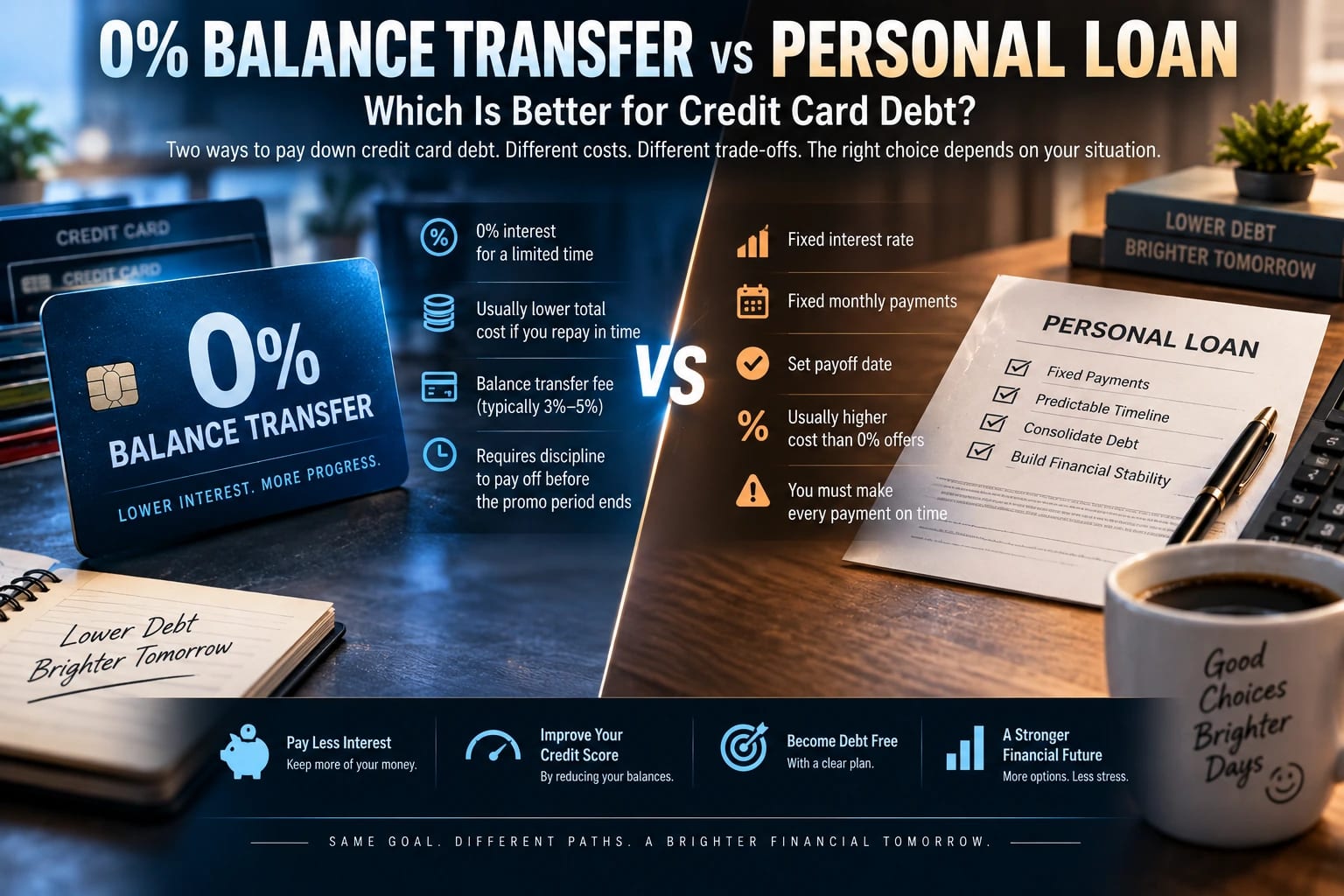
0% Balance Transfer vs Personal Loan: Which Is Better for Credit Card Debt?
A 0% balance transfer may save more if you can repay the debt during the promotional period. A personal loan offers fixed payments and more time. Compare the real costs before choosing.

Fresh Reporting
Browse All Stories →Latest from The Ledger
0% Balance Transfer vs Personal Loan: Which Is Better for Credit Card Debt?
A 0% balance transfer may save more if you can repay the debt during the promotional period. A personal loan offers fixed payments and more time. Compare the real costs before choosing.




Leave a Comment
Your email address will not be published. Required fields are marked *